
Happy, Profitable Clients – Using Split Testing to Create Stronger Client Relationships
WHY IS THIS POST WEIRD?
Happy, Profitable Clients
Using Split Testing to create stronger client relationships
Tom Carless – Creator, AB Split Test
For The Admin Bar 💯
About Me
I ran a WordPress agency managing over 100 sites.
Started to need to test updates.
Tried every tool out there, hated them all.
So I built my own.
That was 8 years ago. Now, AB Split Test has helped thousands of WordPress sites unlock millions in almost-missed revenue – the kind of money that was already sitting in their traffic, just waiting for someone to find it.
Today I’m going to show you how to do the same thing for your clients.
The Problem We All Know
You built the site. It looks great. The client signs up for a care plan.
Then the website just… sits there.
You’re doing the work – plugin updates, security, backups, uptime monitoring. But most of that work is invisible.
Eventually someone asks the dreaded question:
“So… what are we paying for again?”
Send them the WOM and pray…
Or Worse…
The agency down the road swoops in promising “big improvements” and a “fresh perspective.”
They have a crappy Wix website, but a better promise.
Most client relationships don’t fall apart because you aren’t doing a great job.
They get curious about what else there is out there.
What If Maintenance Felt Like Growth?
Imagine your next client check-in sounding like this:
“Last month we tested a new headline on your homepage. It increased enquiries by 18%. We’re now testing your pricing page to see if we can improve that too.”
You’re actively growing their business.
Rather than waiting for them to look elsewhere, you are productizing their curiosity.
Will this client stay for a few months, or years?
What is Split Testing?
More money with the same traffic.
Split testing (A/B testing) = show some visitors version A, some visitors version B, and measure which one gets more people to the goal.
- Version A = what’s there now (the control)
- Version B = your idea for something better
- Version C,D,E… (if you want/need)
- The tool splits traffic automatically and tells you which one wins
If B wins → ship it. If B loses → no harm done, revert automatically.
Unlimited upside. Very limited downside.
What is it for?
Many things an Agency can use Split Testing for…
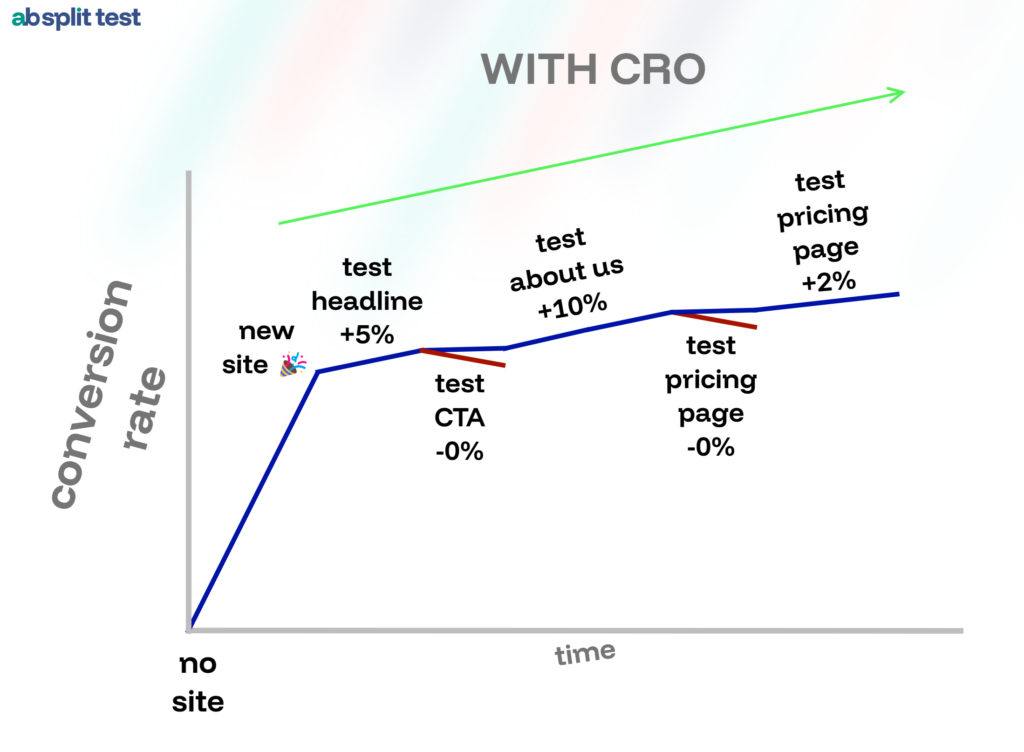
- Conversion rate optimization – methodically improve websites conversions, test your ideas and keep the winners. Incremental improvements with outsized return.
- Feature rollouts – launching a checkout, form or feature? Roll it out to percentage of visitors first and make sure it doesn’t tank conversions before going all-in.
- Measuring updates – client wants a new homepage design or change the contact form? Test it against the current one. Now you have proof it was worth the work (or proof it wasn’t, before any damage is done).
- Adding value to care plans – Give the people interesting data that keeps them engaged.
- Managing HiPPOs – the Highest Paid Person’s Opinion. When the CEO says “make the logo bigger,” you can say “let’s test it.” Data beats opinions every time.
Why This Matters for Agency Owners
Money, Power, Respect.
According to The Admin Bar’s latest agency survey:
- CRO selling agencies are twice as likely to pay themselves over $100K/year
- Many reported $20,000+/mo in recurring revenue
- They charge higher hourly rates (avg. $112 vs $93)
Split testing turns your knowledge into visible, measurable progress the client can see, feel and value.
- It gives you something real to talk about at every check-in
- It creates proof of value – real numbers the client actually cares about
- It makes you hard to replace – you’re the one improving their revenue, not just a good website host
- It justifies higher retainers – “growth” is worth more than “maintenance”
So what are we actually doing?
Sounds good, but where do I click?
Your job as a CRO expert is to define goals and create improvement ideas.
A business generally has one goal. Sell something. When testing, we define a goal as close as possible to that sale:
- Purchase / Sign up / Book – ideal. As close to the money as you can get.
- Contact / Engage – fluffy. A button that gets clicked 20% more but leads to zero extra sales hasn’t done anything useful.
Sit down with the client and ask: “What does a win look like for your website?” That answer is your conversion goal. Every test gets measured against it.
Ideas are the hard part – without a process. That’s where idea generation comes in:
- Analytics / Heatmaps / Session replays
- Surveys
- Checking against best practice
The Simple Process: Diagnose → Idea → Try
You don’t need a complicated framework. Just three steps, repeated monthly:
1. Diagnose
Look at the data and find the most expensive problem.
- Which pages get the most traffic but the fewest conversions?
- Where do people drop off?
- What are heatmaps and session replays telling you?
- What questions keep coming up in the client’s enquiries or live chat?
2. Idea
Turn the diagnosis into a simple hypothesis:
“Because [evidence], if we [change], then [metric] should improve.”
Example: “Because heatmaps show nobody scrolls past the hero on mobile, if we move the phone number and CTA above the fold, then mobile enquiries should increase.”
3. Try
Build the variation. Run the test. Wait for enough data. Ship the winner or learn from the loser.
Then do it again next month.
A ‘Monthly’ Cadence That Works
Low traffic – quarterly, high traffic – weekly.
Here’s what a CRO month looks like inside a care plan:
Week 1: Review last month’s test results. Diagnose the next opportunity.
Week 2: Build the variation and launch the test.
Weeks 2–4: Let the test run. Collect data. Don’t peek and declare a winner early.
End of month: Read the results. Ship the winner (or document the learning). Send the client a report.
Total time: 1-4 hours per client per month. That’s it.
The Client Report
This is where the magic happens. This is the thing that makes clients say “this is exactly what I’ve been wanting.”
A good monthly report is simple:
- What we tested – one sentence
- Why we tested it – the evidence that led to the experiment
- What happened – the numbers (We link to our own reports here, you can make your own)
- What we’re doing next – the next test in the pipeline
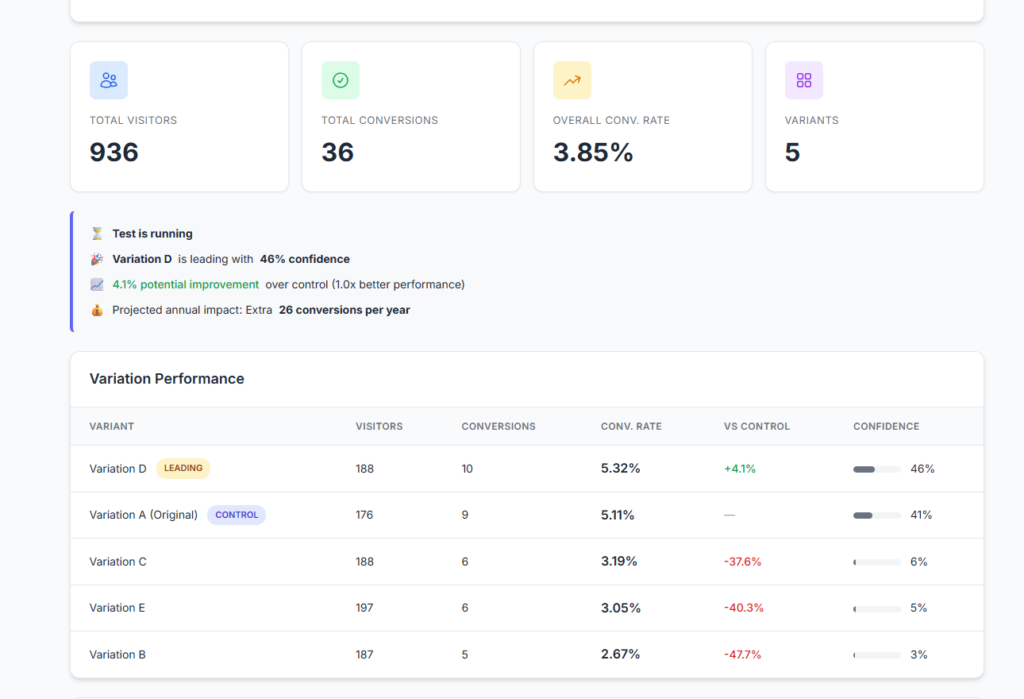
Clients don’t need to understand statistics. They need to see: “We tried this. It worked. Here’s how much better it is. Here’s what we’re trying next.”
That’s a conversation that keeps clients engaged, excited, and paying.
The First Test Is Free
Don’t pitch CRO as a new service. Just do it.
- Pick one client – ideally one with decent traffic and a conversion goal you can measure (form fills, purchases, bookings).
- Run one test for free. Look at their highest-traffic page, find one obvious problem, build a variation, and let it run for a few weeks.
- Show them the result. Win or lose, you now have something concrete to talk about. “We tested X, here’s what happened.”
If the test wins, you’ve got a case study and a natural conversation: “Want us to keep doing this every month?”
If it doesn’t win, you still showed initiative and a process. The client sees you thinking about their business, not just keeping the lights on.
No risk for you or the client. One test is all it takes to start the conversation.
What the Monthly Service Looks Like
Once you’ve got the first win, here’s what you’re actually selling:
What’s included each month:
- Review heatmaps and analytics to find the next opportunity
- Build and launch 1 test
- Monitor the test and read the results
- Ship the winner (or document the learning)
- Send a simple report to the client
Your time: 2–4 hours per client per month.
What to charge: $200–500/month as an add-on to an existing care plan, or bake it into a $300–500/month “growth plan” from day one. Either way, the math works – you’re adding a few hours of high-value work that the client can actually see and feel.
For new clients, position it as the default: “Our care plans include ongoing optimization – we don’t just keep the site running, we make it work harder every month.”
You Already Have Everything You Need
You might be thinking “I’m not a CRO expert.” You don’t need to be.
- You know the site. You built it. You maintain it. You already know where the weak spots are.
- You have admin access. You can install a plugin, create a variation, and launch a test in an afternoon.
- You see the analytics. You probably already know which pages get traffic and which ones don’t convert. That’s your starting point.
- The plugin does the hard part. Splitting traffic, tracking conversions, calculating results – that’s all handled for you.
- AI can help. Use it to generate test ideas, write variations, and interpret results. You don’t have to come up with everything from scratch.
Start with one client. Get comfortable. Then roll it out across your roster. By the third or fourth client, you’ll have a repeatable process that takes less time and produces better results.
The Numbers of Keeping Clients Longer
Let’s say your care plan is $150/month and the average client stays 12 months. That’s $1,800 lifetime value.
Now add CRO to the retainer. Charge $300/month instead. The client stays 24 months because they can see measurable improvement every single month.
$300 × 24 = $7,200 lifetime value. That’s a 4x increase.
And the extra work? 2–4 hours a month.
Care Plan Value-Add
Including CRO tools in your Base-level plan is a simple way to stand out and show your clients you care about their results.
Get better results for these clients, verify major updates, generate heatmaps and session replays. Giving more data than your competitors.
What About Low-Traffic Sites?
This is the most common objection: “My clients don’t get enough traffic to test.”
- 500+ visits/month to the page you’re testing is enough for most element tests. You won’t get results in 3 days, but you’ll get them in 3–4 weeks.
- Test bigger changes. On low-traffic sites, don’t test a button colour. Test a completely different headline, a different page structure, or adding/removing a whole section. Bigger changes produce bigger signals.
- Focus on the highest-traffic page. Every site has one. Usually the homepage. Start there.
- Even if you can’t run a statistically perfect test, the process of diagnosing problems, proposing solutions, and measuring results is still 10x better than guessing. CRO process still is helpful, even without the actual ‘test’
Recap
- Client relationships die when progress is invisible. Split testing makes it visible.
- You already know the site. You already have the access. The barrier is tiny.
- Diagnose → Idea → Try. Monthly. 2–4 hours.
- One simple report turns “maintenance” into “growth.”
- Clients stay longer, pay more, and refer you – because they can see the results.
Try It – Zero Risk
AB Split Test has a 7 day demo. Install it on your own site or a client’s site. Generate heatmaps & session recordings of your users, and chat with our trained AI that can analyze your site and create optimizations for you in seconds, just by chatting with it.
After 7 days, free forever version lets you manually create AB tests whenever you like free forever.
No commitment. No credit card. Just evidence.
- Get the plugin: absplittest.com
- Get a free audit: We’ll look at your site (or a client’s site) and tell you what we’d test first
- Generate heatmaps: See where your visitors are clicking, scrolling, and dropping off – then decide if there’s something worth improving
The worst case? You learn something about your site. The best case? You find a new revenue stream that keeps clients happy for years.
Thanks! Questions?