
AB Split Test Data, Storage & Reporting
If you have question about how we store data. read on!
Basic Data Flow
- Visit/goal/conversion data received from website visitor
- Data is processed by your server and statistics are updated.
- Individual visit data may be saved or removed.
- If advanced tracking is enabled, visit data is saved to abst_fingerprints table.
- Otherwise, granular visit data is removed.
Where does AB Split Test store my experiment data in the database?
Your tests and settings (configuration)
Each test is a custom post type, so its configuration lives in the standard wp_posts and wp_postmeta tables (variations, goals, conversion rules, and so on).
Counts and statistics are saved in a custom table
Your results (visits, conversions and statistics) are stored in the {wp prefix}abst_results table - one row per test, with the per‑variation tally held under the observations column. Incoming events waiting to be tallied are buffered in {wp prefix}abst_queue. (In older versions, results were stored in wp_postmeta under the observations key.)
Advanced tracking data stored in custom table
{wp prefix}abst_fingerprints
Migrating between staging and production
When syncing a staging site to production, exclude the results tables - wp_abst_results, wp_abst_queue and wp_abst_fingerprints - so your live data isn’t overwritten, and sync wp_posts/wp_postmeta to carry your test configuration across.
How does data storage change when advanced tracking is enabled?
Advanced tracking keeps individual visitor data in your abst_fingerprints table.
Can I export split test data or reporting results for external analysis?
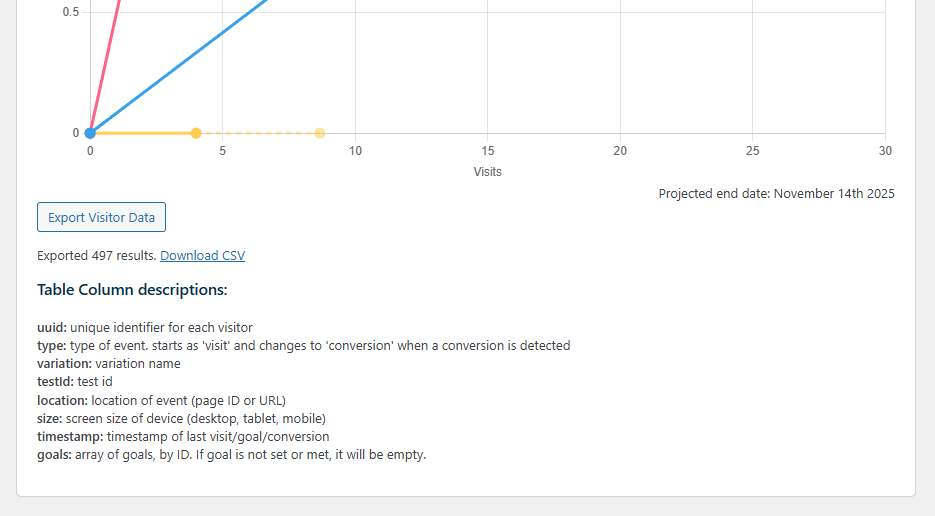
Yes! under your test results, you can now export a CSV of your visitor data.
Is any personal data (IP address, email, user ID) collected or stored by AB Split Test?
No IP address is ever used or processed unless you are using fingerprint conversions.
If you use fingerprint conversions, we keep a one-way hash of the user IP address, and some device statistics like browser size, user agent).
Because of the one-way hash, the user cannot be traced to the original IP address.
Is the plugin fully GDPR-compliant for agencies and regulated environments?
We store no user identifying data, and still work with cookies completely blocked (fallback to localstorage).
What security safeguards protect my test/conversion data?
We sanitize any incoming data to ensure no XSS or security vulnerabilities.
We filter out traffic that is a bot or scraper (where possible, not spoofed by the bot)