
Multi-Armed Bandit - Continuous optimization mode
Teams Included on the Teams plan. Not available on the Lite version. Upgrade →
What is Multi-Armed Bandit?
The Multi-Armed Bandit (MAB) is a smart traffic allocation mode designed to send more visitors to your highest-converting variation while the test is still running.
Unlike Bayesian mode (our standard testing approach), which focuses on providing statistical confidence after the test ends, Multi-Armed Bandit continuously adjusts traffic in real time. This allows you to capture more conversions during the test, instead of sending equal traffic to losing variations.
How it Works
- Even Start
All variations receive an even split of traffic until the test has recorded 30 conversions in total (orders, on order-value tests). This gives every variation a fair opportunity and ensures a reliable sample. - Dynamic Weighting
After that, traffic is rebalanced every 2 hours toward the variation most likely to be the best. The clearer its lead, the more traffic it gets. Each update moves halfway to the new split, so traffic shifts gradually. (Version 2.6.13 and later. Earlier versions split traffic in proportion to each variation’s conversion rate, so the split moved much less.) - Minimum Weighting
Every variation always keeps a share of traffic, so a late winner can still show up:- 2 variations: each keeps at least 10%, so the leader gets at most 90%.
- 3 or more variations: each keeps at least 5%. With 3 variations, the leader gets at most 90%.
- Order Value Tests
When a test optimizes for order value, one large order can make a variation look like the winner. So the leader’s share also grows with the orders of whichever variation has the fewest. With 2 variations: 62% at 30 orders, 70% at 50, the full 90% at 100 orders. (Version 2.6.13 and later.) You can change the 100 with a filter.
This approach balances exploration (still testing all options) with exploitation (favoring the winner).
How to Use
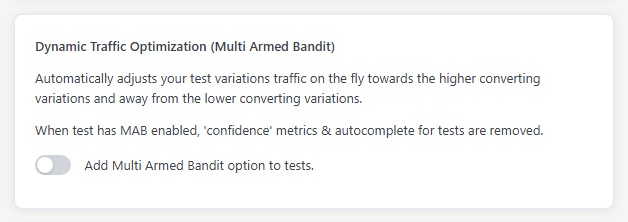
To create a test with Continuous Optimization, you must first enable it from the settings.
Enable in AB Split Test > Settings > Testing > Dynamic Traffic Optimization (Multi Armed Bandit) > Add Multi Armed Bandit option to tests.
Create a new test - Any test type
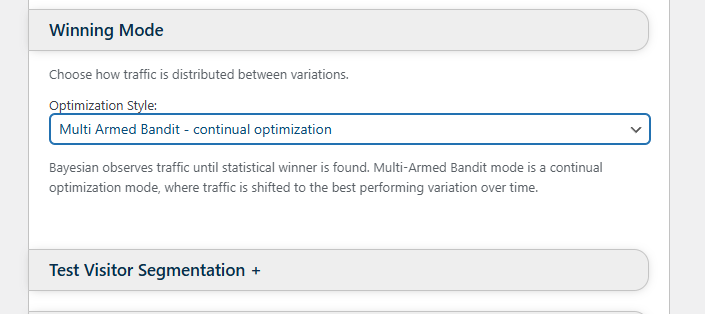
Choose Dynamic - Multi Armed Bandit as the Winning Mode
When to Use Multi-Armed Bandit
Choose Multi-Armed Bandit when your goal is to maximize immediate conversions during the test period. It’s ideal for:
- Short-lived campaigns (e.g. promotions, seasonal sales, news articles).
- Revenue-critical experiments where you can’t afford to waste traffic on poor variations.
- Situations where speed matters more than certainty.
When to Use Bayesian (Recommended Default)
We usually recommend Bayesian mode for most experiments. Bayesian testing is designed to provide statistically confident results that you can rely on for long-term decisions. It’s best for:
- Ongoing or permanent changes (e.g. homepage design, pricing tests).
- Long-running experiments where accuracy is more important than speed.
- Strategic team decisions where certainty is critical.
If you’re on the Lite version, you’ll still have access to Bayesian mode - the best choice for most split tests.
Legacy licenses with more than 20 site licenses will have Multi Armed Bandit mode.
With AB Split Test, you have the flexibility to match your testing mode to your business goals.